 Stratify
I asked ChatGPT to backtest an options strategy. Here's where the answer actually came from.
Why we built a backtester that your AI talks to, instead of an AI that pretends to backtest.
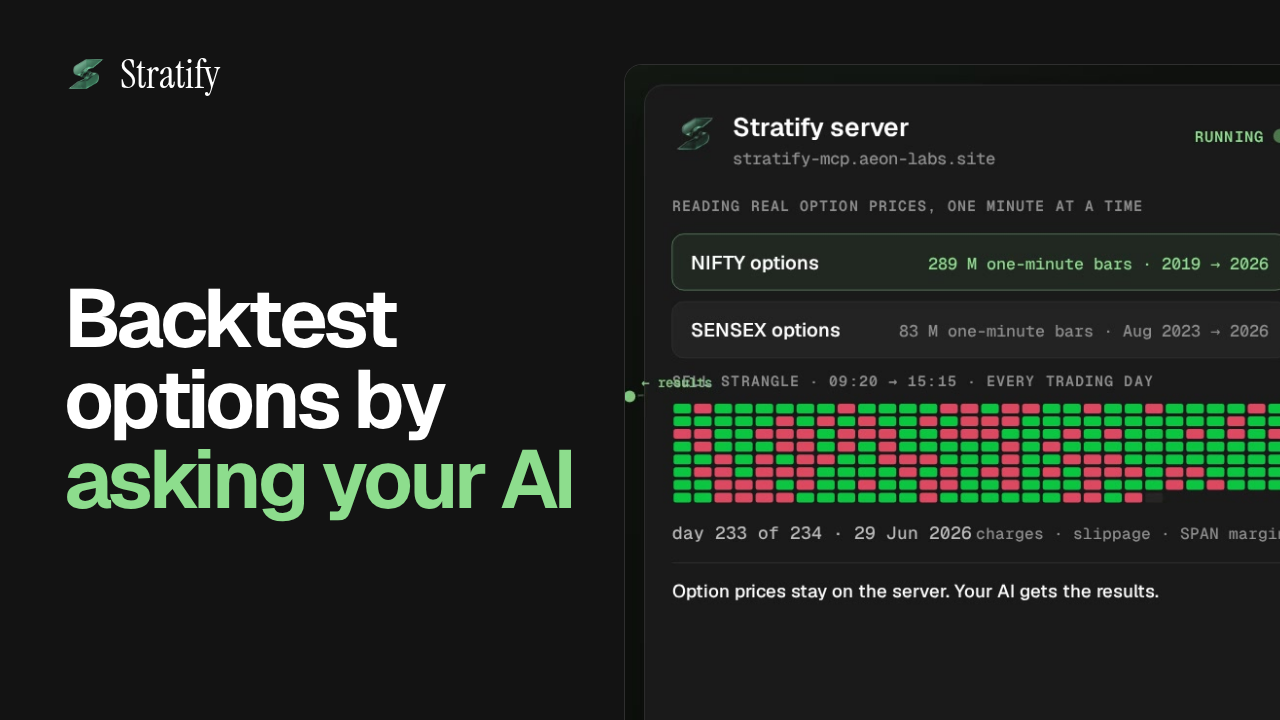
Ask a chatbot how selling a NIFTY strangle every morning would have done last year, and you'll get an answer. It will be fluent and specific, with a win rate, a rough profit figure and a sensible-sounding caveat about volatility. It will also be invented. A language model has no option chain from last October in it, and it can't price a strangle at 09:20 on a Tuesday. What it can do is produce text that looks like a backtest.
That gap is why we built Stratify. The AI does the part it's genuinely good at: turning "sell a strangle half a percent from spot, exit at quarter past three, stop at twice the credit" into a precise strategy. Then it hands that strategy to a server that does the part it can't do: running it against what actually happened, minute by minute.
Where the backtest runs
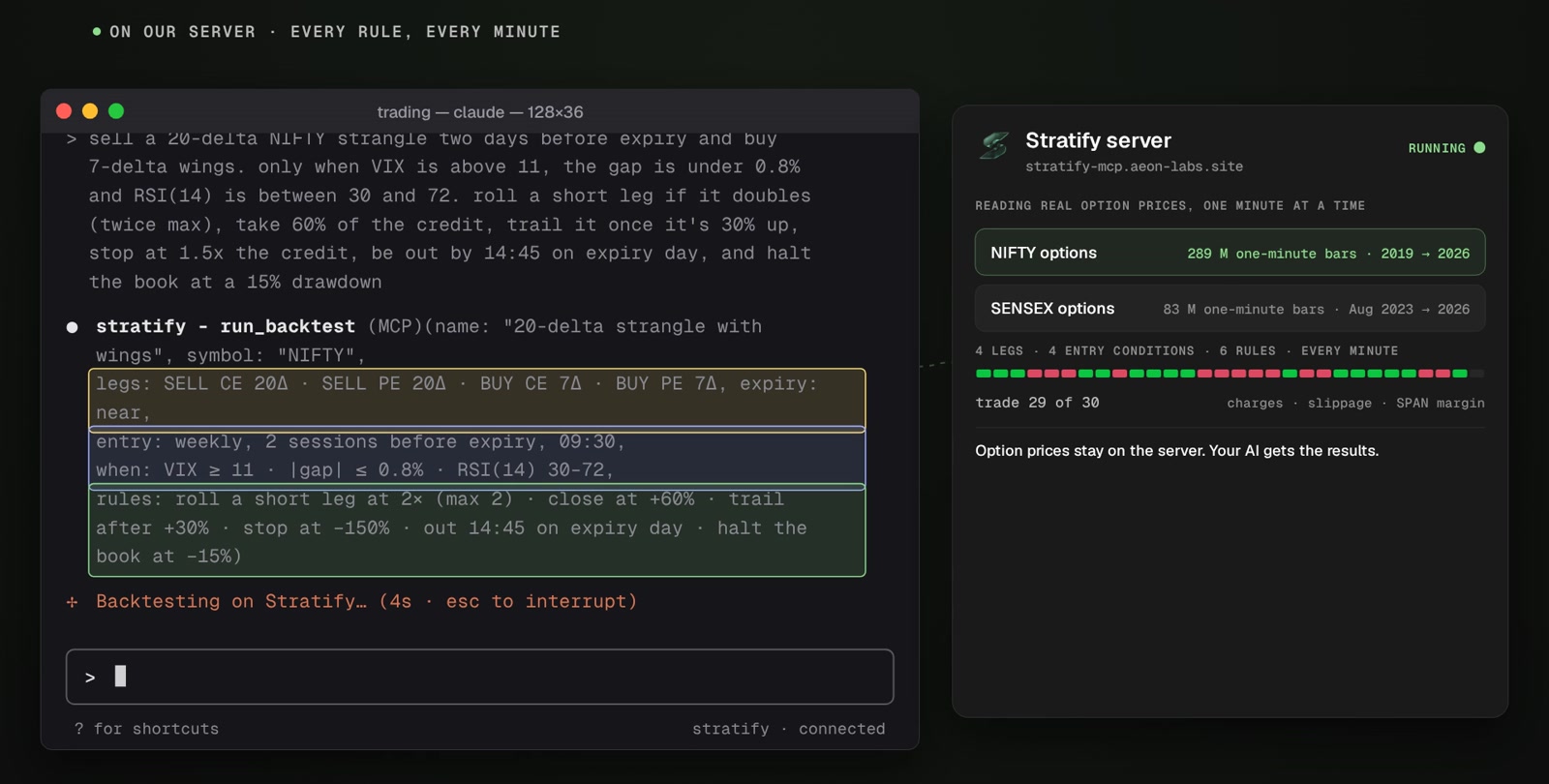
Stratify is an MCP server. MCP (Model Context Protocol) is the standard way ChatGPT, Claude and other assistants call outside tools. When you ask for a backtest, this is what happens:
- Your AI writes a spec. Your sentence becomes a structured strategy: which index, which strikes, when to enter, when to exit, what stops. You can see exactly what it sent.
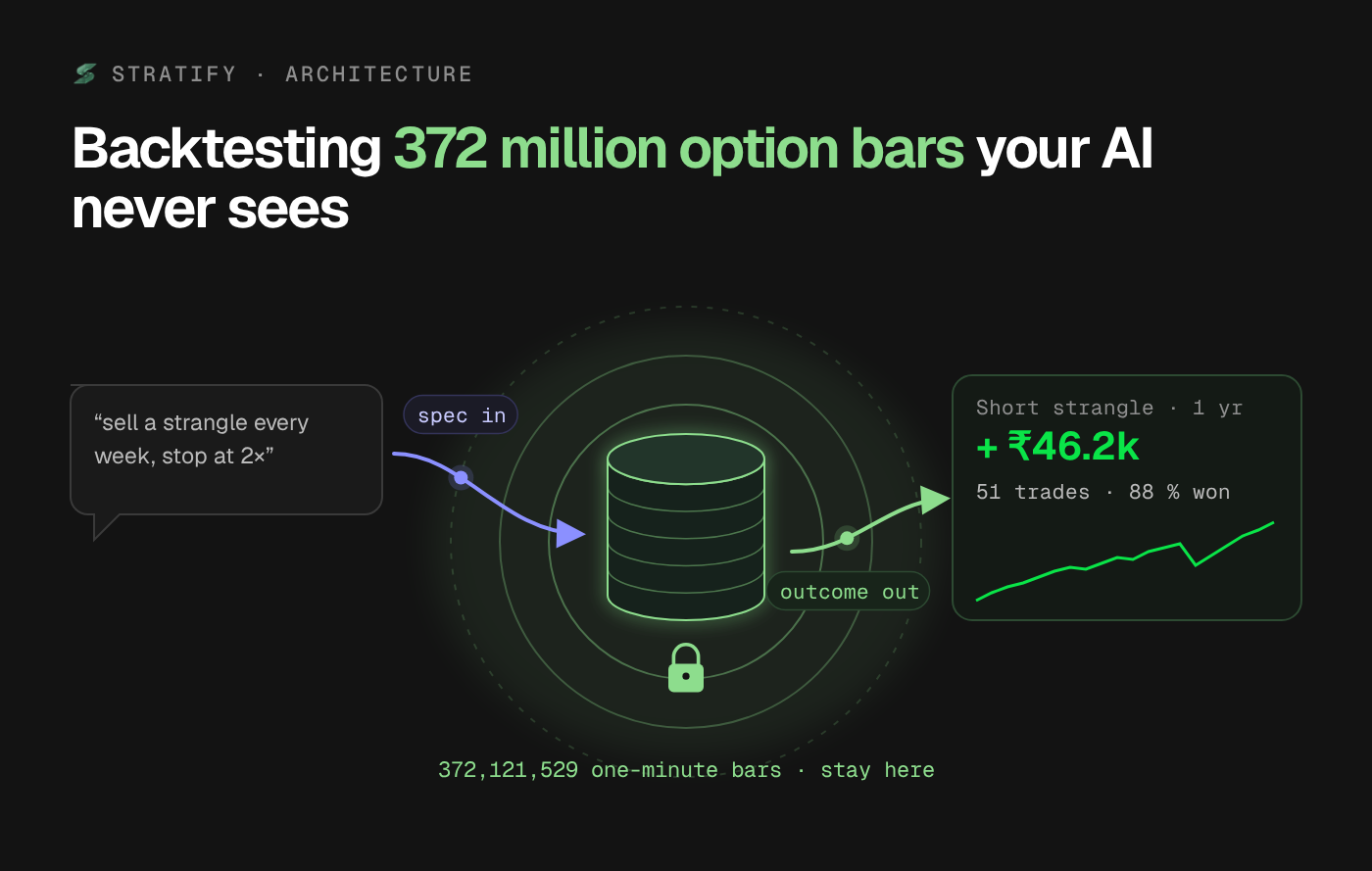
- Our server runs it. The engine replays the strategy against 372 million one-minute option bars: 289 million for NIFTY and 83 million for SENSEX. Every trade is charged the way a broker would charge it: brokerage, STT, exchange fees, SEBI fees, GST, stamp duty and a slippage allowance on every fill. Margin is SPAN-calibrated, so "return on margin" means something.
- Results come back. Your AI gets trades, P&L after charges, drawdowns, walk-forward results, a verdict and a link to a full report. It never gets the option prices themselves. Those stay on the server.
That last point is a constraint, not a feature we invented for marketing: we can't redistribute historical option prices. It also turns out to be the right design. Your AI doesn't need the chain. It needs the answer, computed by something that has the chain.
A real example
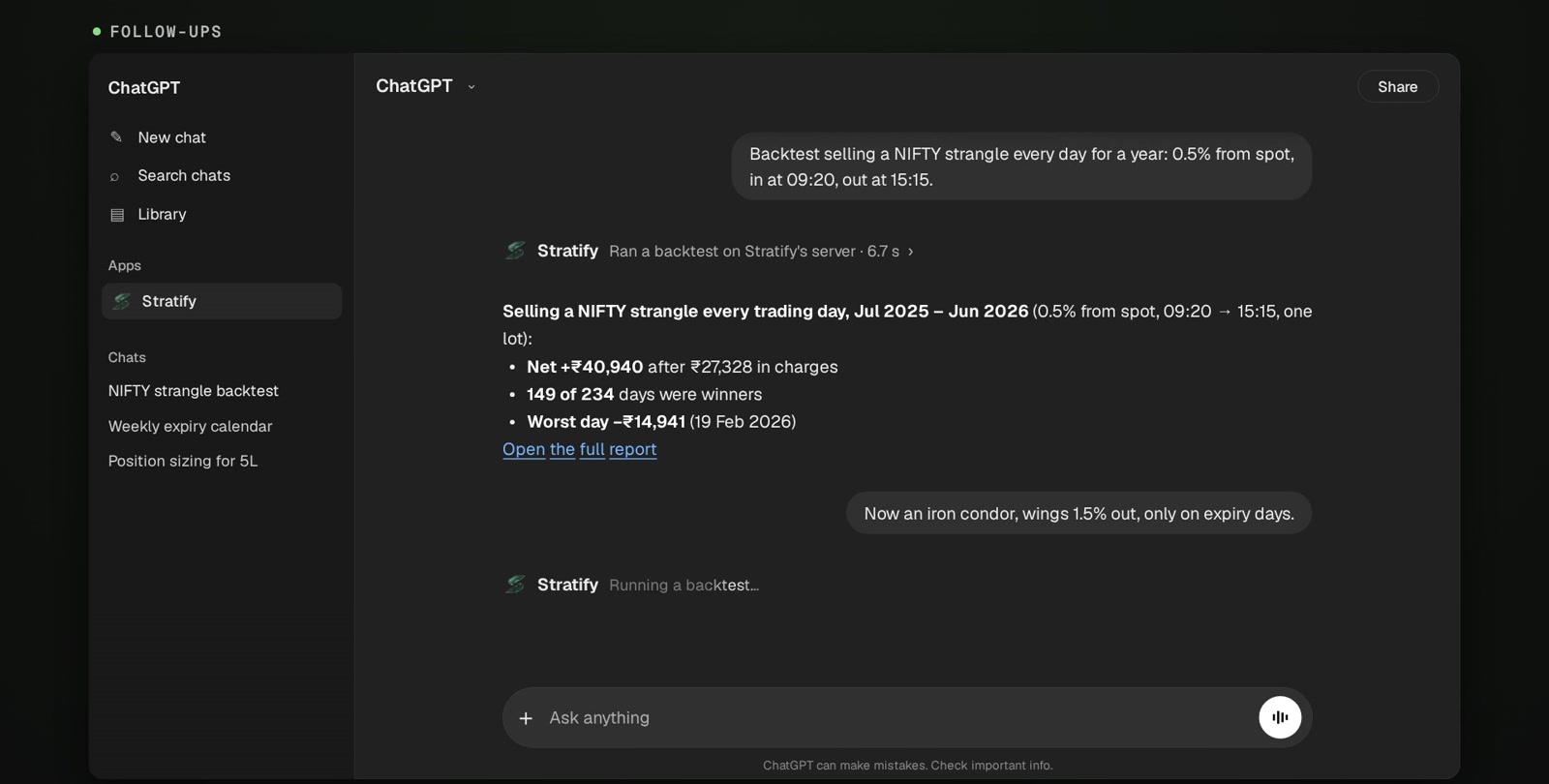
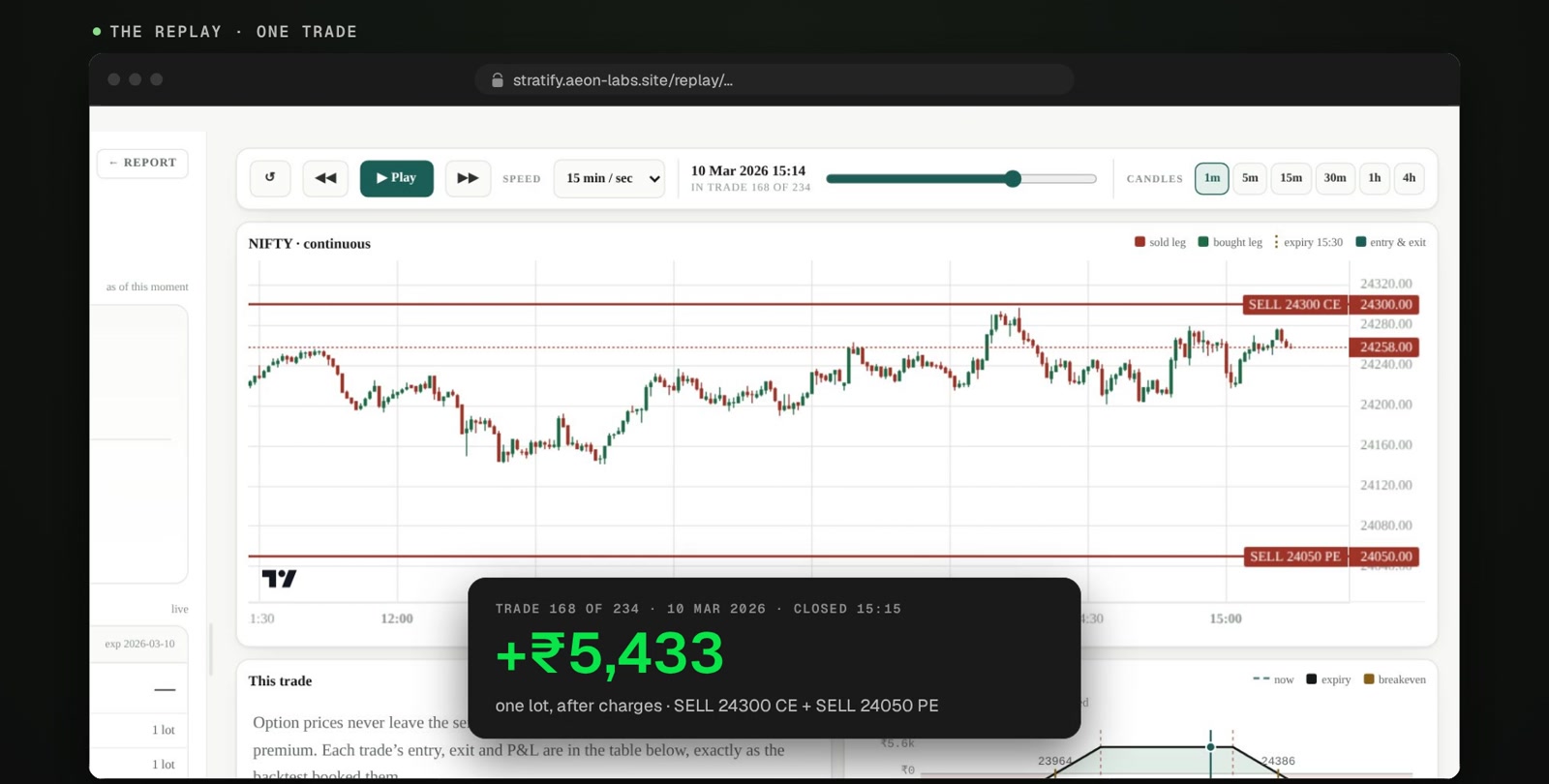
Here's a strategy straight from our walkthrough video: sell a NIFTY strangle every trading day for a year, strikes 0.5% from spot, in at 09:20 and out at 15:15, one lot.
- Net: +₹40,940, after ₹27,328 in charges
- 149 of 234 days were winners
- Worst day: −₹14,941
Two things in those numbers are worth slowing down for.
First, charges were 40% of the gross profit. Most backtests shared online, in spreadsheets, forum posts and YouTube videos, leave charges out or use a flat guess. For a strategy that trades every day, charges aren't a footnote. They decide whether the strategy works at all.
Second, the verdict on this strategy was that it failed its out-of-sample test. Stratify splits history, checks whether what worked in one stretch kept working in the next, and says so plainly when it didn't. A tool that only ever tells you good news is a slot machine with a nicer interface.
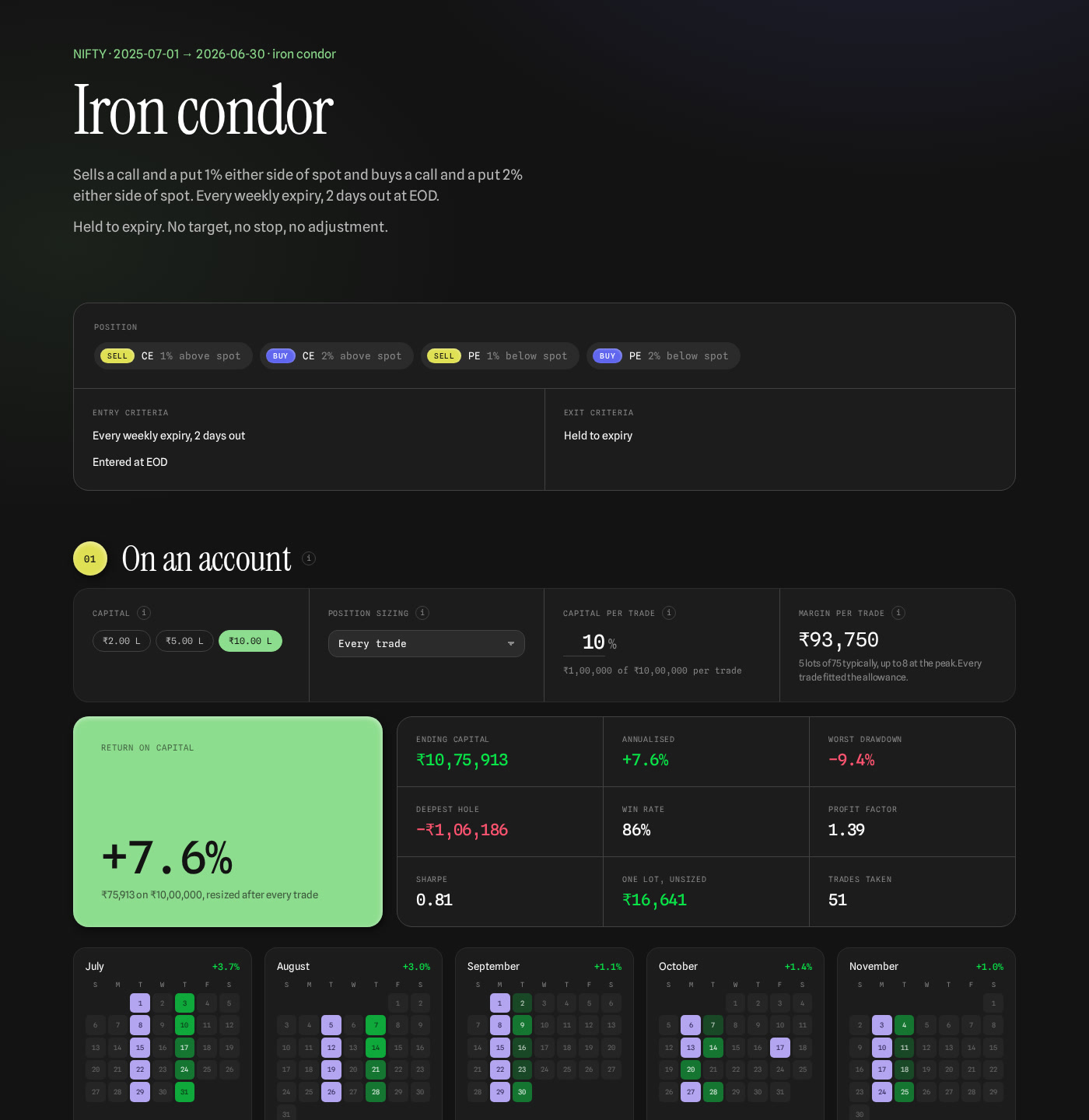
Here's a second run, made while I was writing this: an iron condor, strikes 1% out, wings 1% wide, entered two days before expiry, over the free year. It made ₹16.6k over 51 trades with an 86% win rate. That sounds great until you read the next line: the worst drawdown was ₹18.6k, bigger than the entire year's profit. The win rate was real. It just wasn't the number that mattered.
Details that make backtests lie
Most of the work on Stratify went into the unglamorous places where options backtests quietly go wrong:
- Stops on one-minute bars, not daily closes. Checking a stop-loss once a day at the close let trades survive intraday moves that would really have stopped them out. Resolving stops minute by minute cut reported P&L by about 10% on the strategies we checked.
- No peeking at the entry day. Entry conditions such as "only if RSI is neutral" read the previous close. We found one place where a signal could see the day it was trading, fixed it, and re-ran everything.
- Expiry-day reality. Exchanges charge extra margin on expiry day, and the engine charges it too. Since August, the official closing price can differ from the last traded price, so signals read the official close. The methodology is versioned, so every result says which rules produced it.
- Sparse chains. When the strike you asked for didn't trade that minute, the engine doesn't make up a price. It re-centres the trade or skips it.
What it looks like to use
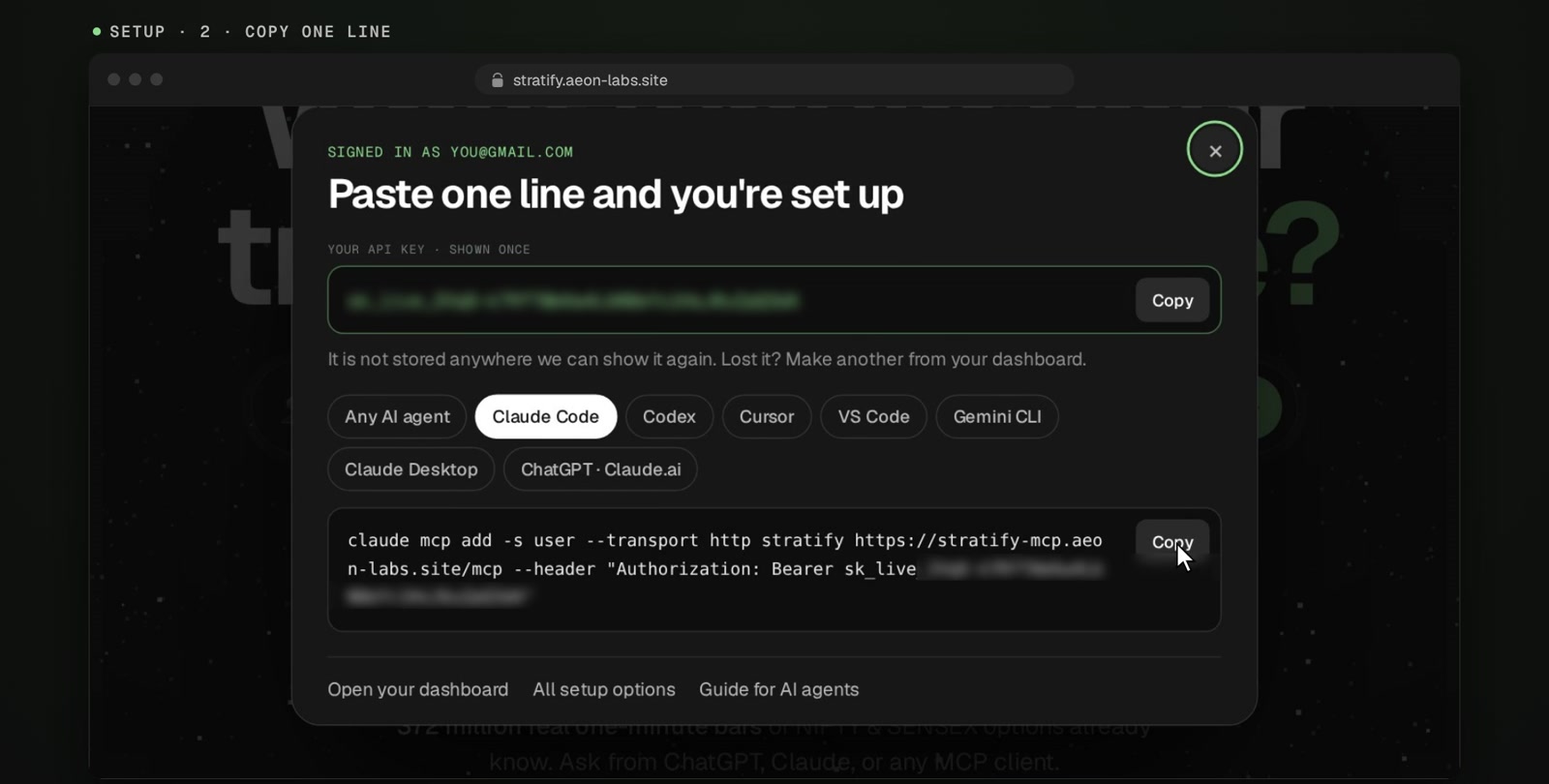
Setup takes about twenty seconds. Go to stratify.aeon-labs.site and continue with Google. In ChatGPT, Stratify is a published app: search for it and connect. In Claude, Claude Code or Cursor, you paste one line or one URL. Then ask:
> "Backtest selling a NIFTY iron condor two days before expiry, 1% out, 1% wide, over the last year."
The AI shows you the spec it built, runs it, and summarises the result. Ask for the report and you get a hosted page with the equity curve, every trade, the walk-forward folds and the verdict. Ask for a replay and you can step through a single trade minute by minute. More complex strategies are possible too: multiple legs, rolls and adjustments, time-based exits. They're described in plain English and run through an open "legs and rules" format.
What it won't do
Stratify won't tell you what to trade. It won't size a position, pick a day to act, or answer "what would you do?". That's built into how it instructs the AI, not stuck on as a disclaimer. It doesn't place orders. It's a historical simulation, one lot, after charges. Past results are evidence, not a forecast.
There are honest limits, too. The free tier covers the last year (July 2025 to June 2026) for both NIFTY and SENSEX. Longer history (NIFTY back to 2019, SENSEX from August 2023, when its options start) will be a paid tier. On SENSEX, the open legs-and-rules format isn't available yet; the preset structures (strangle, iron condor, iron fly, credit spread, long option) are.
Try it, and try to break it
It's free to use for the last year of both indices, with 100 backtests an hour. The server code is open source under the MIT licence.
- Use it: stratify.aeon-labs.site
- MCP URL: stratify-mcp.aeon-labs.site/mcp
- Read the code: github.com/Srinath-exe/stratify-mcp
If a number looks wrong to you, that's the most useful thing you can tell us. Every result carries its spec and its trade log, so every claim here can be checked, which is the whole point.
---
Stratify runs historical simulations for research and education. Nothing here is investment advice. ChatGPT, Claude and Claude Code are trademarks of their owners; Stratify is independent.
Backtest NIFTY and SENSEX options from ChatGPT or Claude. Free for the last year of data.
Start free with GoogleMore guides
 Guide · 4 min read
How to Backtest Options Strategies with AI: ChatGPT and Claude on Real NIFTY and SENSEX Data
Backtest NIFTY and SENSEX options strategies by asking ChatGPT or Claude. Real one-minute option prices, every charge included. Free for one year of data.
 Engineering · 3 min read
Backtesting 372 Million Option Bars Your AI Never Sees: A Compute-to-Data MCP Server
How an MCP server backtests options on 372 million one-minute bars without the data leaving: architecture, measured capacity and scaling.